Souring Sugar, Lost Cotton: The Price of Pakistan’s India Boycott

 an hour ago
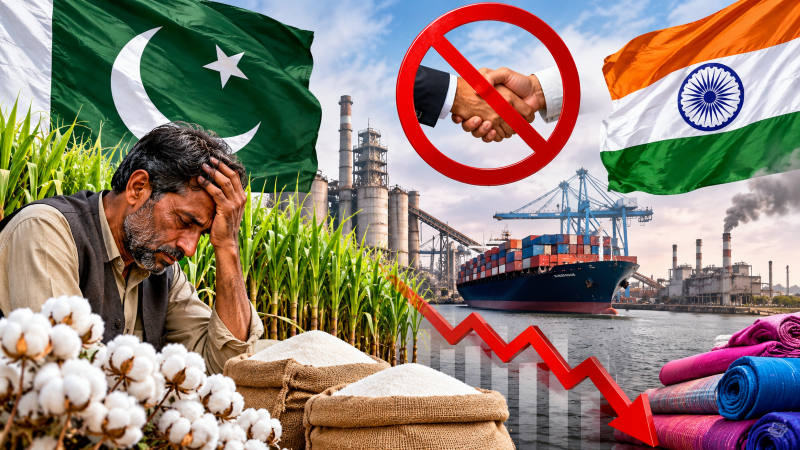
The self-inflicted suspension of trade with India following the revocation of Article 370 in 2019 has dealt a devastating blow to Pakistan’s fragile economy. Confronted with skyrocketing sourcing and logistics costs from importing goods through distant foreign markets, the country has suffered estimated economic losses of around $40 billion. While indirect trade continues covertly through third-party hubs like Dubai, Singapore, and Colombo—funneling roughly $10 billion worth of Indian goods annually through altered documentation—this shadow trade enriches middle countries while stripping the government of vital customs revenues. Consequently, legal bilateral trade has fallen to a negligible trickle, leaving Islamabad isolated from its largest regional neighbor.
This self-imposed embargo has severely crippled key Pakistani industrial sectors, most notably cement and textiles. The cement industry, representing roughly 73 percent of the domestic manufacturing sector and anchored by politically connected giants like army-owned Fauji Cement, faces shrinking domestic demand and blocked export routes into neighboring borders like Afghanistan. Similarly, the agriculture and textile domains suffer from severe systemic missteps. Driven by short-sighted policy failures, sugarcane cultivation has aggressively encroached on traditional cotton belts. This shift has crippled national cotton output and forced Pakistan’s garment sector to rely on expensive foreign raw cotton, undermining its most valuable export market.
The stark contrast between the two economies underlines the absolute asymmetry of the relationship. While India's global trade trajectory continues its steady expansion toward ambitious trillion-dollar targets, Pakistan's merchandise exports have contracted sharply, rendering its current financial position unsustainable. Regional business bodies and chamber research have repeatedly highlighted the mutual economic potential of intra-South Asian trade, which could unlock tens of billions in unrealized value while creating vital employment along cross-border logistics routes like the Attari border. Simply put, while New Delhi can comfortably thrive without trade with Islamabad, Pakistan's domestic market cannot sustain such prolonged isolation.
At the heart of this persistent crisis lies Pakistan's structural reliance on military dominance over civilian governance. Unlike democratic leaders who face electoral pressure to ensure economic prosperity and employment, the military establishment historically thrives by inflating external security threats to justify its oversized influence. Powerful political figures such as Imran Khan and Shehbaz Sharif have consistently abstained from initiating trade normalization with India, fully aware that challenging the military's anti-India posture would spell immediate political and physical ruin.
Untying this Gordian knot requires a fundamental shift in national priorities that only a visionary military leadership prioritizing civilian economic survival over institutional hegemony can deliver. Until the establishment steps back to allow elected leaders to rebuild economic bridges with India, Pakistan will remain trapped in a cycle of economic contraction, internal unrest, and mounting financial dependency. Given the current institutional dynamics in Islamabad, meaningful trade reconciliation remains a distant prospect.





[[comment.comment_text]]