When Citizens Become Guinea Pigs

 3 months, 1 week ago
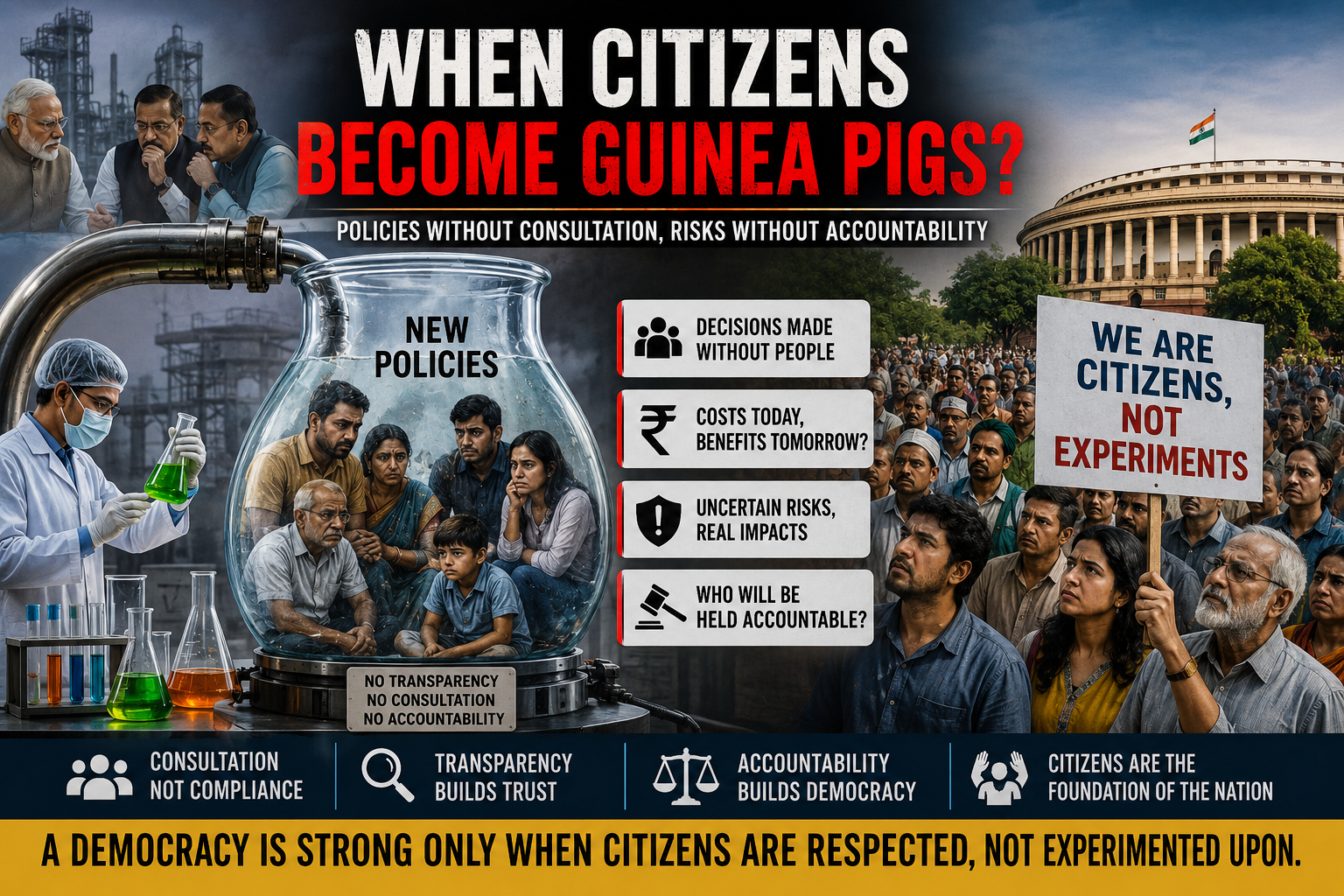
Governments are elected to create policies for the people in a democracy, not to test them. Citizens are the fundamental cornerstone of democratic legitimacy, not the objects of a scientific experiment. The uncomfortable question of whether citizens are partners in development or merely test subjects in a government laboratory always comes up when policies are implemented on a regular basis that have immediate consequences that are borne by common people, long-term outcomes that are uncertain, and potential risks that have not been adequately discussed in public.
The quantity of new programs a government introduces is not the only indicator of development. Clear accountability, extensive public consultation, and deliberate policymaking based on scientific data are necessary for true progress. Democracy has a duty to address any reasonable concerns raised by citizens when the stated advantages of a programme are somewhere in the future and its present costs are borne by them through their wallets, their health, their livelihoods, or their daily lives. The term "national interest" alone is insufficient. The national interest and the interests of the population cannot be viewed as distinct or conflicting goals in a democracy.
Ordinary Indians have seen a constant stream of policy changes over the past few years that have altered their daily life. Revisions have been made to fuel policies. The Social Security regulations have been revised. The use of digital compliance has grown. Tax systems have changed over time. There are now new standards for identification verification. New regulatory frameworks have been applied to consumer markets. Although each change has an official rationale, a recurring issue remains in the public's mind: Were the concerns of individuals who will be affected by these decisions truly taken into consideration before they were made?
There is a reason for every governmental policy. Decisions made today are investments in a better tomorrow, according to every administration. But good intentions by themselves do not grant credibility in a democracy. Both the method and the goal are important. Public scrutiny is not a barrier—rather, it is the fundamental component of democratic accountability—if the advantages are anticipated in the future while the risks and financial obligations fall on citizens today.
The same basic question is raised by citizens regarding policies that directly impact consumers, such as the introduction of E20 ethanol-blended gasoline, modifications to social security regulations, and the expansion of digital mandates: Before these modifications were implemented, was there sufficient consultation? Was an impartial evaluation of their effects conducted? And who will be held accountable in the end if the policy results in unintentional harm?
Therefore, the controversy surrounding E20 gasoline, which contains 20% ethanol, is about much more than a change in fuel composition. Additionally, it is a test of democratic governance in general. Without a doubt, improving energy security, cutting carbon emissions, and raising farmer incomes are important national goals. However, the integrity of a public policy's execution is just as important to its success as its aims.
The government's first duty is more than just announcing the policy when millions of car owners are still unsure about the long-term effects, experts are still at odds over crucial technical issues, and customers keep asking who will be responsible for any unanticipated damage or financial loss. Its primary duty is to foster public trust via open communication, openness, impartial assessment, and a readiness to address challenging issues.
Democracy is strongest when governments gain citizens' acceptance through evidence, accountability, and consent rather than when they beg them to accept policies without inquiry. A citizen is not a test subject in a lab. Every democratic choice is made in the name of a citizen, who is the sovereign.
This is where the most important question of democracy arises: Do individuals still participate in the formulation of public policy, or have they only been used as test subjects? Democracy stops being participatory and starts to resemble a one-way administrative process when people are expected to accept every new policy without sufficient public discussion, open accountability, or genuine consultation.
The amount of ethanol added to fuel is
not the main point of contention about E20. It concerns the nature of governance itself, namely whether legitimate concerns, public trust, and citizen consent continue to play a major role in policymaking. The people in a democracy are the very basis of the legitimacy of the state; they are not test subjects. One straightforward standard must be used to evaluate all reforms: did the people participate in its implementation, or were they just forced to?
Is it enough to reject every issue with the well-known justification that it is "in the national interest" if a policy requires residents to pay more, replace their cars, adjust to new technologies, or accept changes in the nature of their rights and daily conveniences? It is impossible to see the interests of the people and the country as conflicting principles. The ability to balance and reconcile both is a key indicator of excellent governance in a robust democracy
.
The introduction of change by governments is not the biggest worry. Change is both essential and unavoidable. The issue is that reform frequently takes the shape of a directive rather than a conversation. Serious public discussion on the implications of policies doesn't start until after they are introduced. When judgements are almost irreversible, those who are most impacted are left to voice their concerns. Citizens would unavoidably feel that their role has been reduced to compliance rather than participation as a result of such a procedure.
This is the real democratic test. Although governments have the power to create policies, only the people have the confidence that provides those programmes democratic legitimacy. It is only reasonable for citizens to question if they are involved in government or just the initial subjects of its experiment when choices are made before discussion, announcements are made before preparedness, and risks are transferred before protections are put in place.
The people are the source of governments' power. However, this authorisation does not give them the right to use the general population as test subjects. Without years of laboratory research, several stages of clinical trials, stringent independent evaluation, and a thorough analysis of potential side effects, no new medication in science is ever administered to humans. This procedure is based on the simple idea that human life is too valuable to be used as an experiment. Public policy should be guided by the same idea. Decisions that have the potential to impact hundreds of millions of people's lives should be equally committed to caution, accountability, transparency, and evidence.
Therefore, reform itself is not the issue. The strategy that assumes citizens would accept every new policy without sufficient information, significant alternatives, or reliable protections is the source of the issue. In a democracy, trust is developed by conversation rather than by orders. A government's duties go beyond carrying out its mandate. Additionally, it must reassure the populace that in the event of unanticipated difficulties, the state will uphold its obligations and support those who suffer the repercussions.
The average citizen of today is much more than just a taxpayer. They are labourers, farmers, consumers, car owners, business owners, and family guardians. They are always the first to feel the effects of any public policy. When a policy is successful, the system owns the credit. However, the cost is frequently borne solely by the person when it causes unforeseen financial hardships, technological setbacks, or social inconveniences. This asymmetry, in which risk is personalised while achievement is institutionalised, is what progressively erodes public confidence and fosters democratic discontent.
Democratic discourse is essentially lacking if voters in a democracy are merely told that "this is in your best interest" but are never given the chance to enquire, "How, at what cost, and with whose accountability?" The quantity of new laws or significant reforms is not a reliable indicator of progress. Trust is the foundation of true progress. When a policy causes suffering, citizens should have faith that their government will listen to them, take their complaints seriously, and take accountability rather than brushing them off as collateral damage.
In the end, a country's greatest assets are not its factories, roads, bridges, or spectacular economic figures. Its people's trust is its biggest asset. The issue is no longer solely one of governance when individuals start to believe that every new policy tests their ability to tolerate inconvenience and uncertainty rather than their assent. It turns into a crisis of democratic legitimacy. Therefore, the crucial question is not whether change is occurring, but rather whether it is genuinely for the people or just about them.
A mature democracy is distinguished by how seriously it listens before making judgements, rather than how quickly it announces them. Citizens' lives should be made easier by public policy, not made more difficult. A government and its citizens should always have a partnership based on mutual trust, accountability, and consultation rather than a relationship akin to that of ruler and subject.
Therefore, the main problem of today is greater than any one plan, legislation, or change. It concerns a philosophy of governance in which democratic discourse gradually slows down while progress seems to accelerate.
In a democracy, citizens cannot be treated as guinea pigs. They are voters, taxpayers, the ultimate source of constitutional power, and the cornerstone of the state's legitimacy. The issue is no longer administrative; rather, it is a serious erosion of democratic confidence if they start to think that every new policy is first tested on their lives and that answers to their questions are only sought.
Every country must ultimately address one fundamental issue: Are public policies being created in collaboration with the populace or are they being imposed upon them? Every new development promise will be accompanied by a new doubt in the minds of citizens until that question is addressed honestly: Do I take part in this democracy or am I just the next test subject?











[[comment.comment_text]]