Omar Abdullah's Kashmir: A Governance Vacuum New Delhi Cannot Afford to Ignore

 3 hours ago
When elected governments fail their mandates, the void they leave is never neutral in Kashmir, it has always been lethal.
The abrogation of Article 370 in August 2019 was New Delhi's most audacious constitutional wager in independent India's history. Its fundamental premise was elegant: strip away the architecture of exceptionalism, integrate Jammu and Kashmir into the Indian mainstream and replace five decades of secessionist oxygen with the fresh air of accountable governance and economic dignity.
For five years, that gamble appeared cautiously, incrementally to be paying off. The record voter turnout in the 2024 Assembly elections was nothing short of extraordinary. It was Kashmir's weary, battle-scarred populace sending an unambiguous message: we choose ballots over bullets; now deliver.
Eighteen months later, as May 2026 dawns, that message is being answered with a resounding silence from the National Conference government of Chief Minister Omar Abdullah. The silence is not benign. In Kashmir, governance vacuums do not stay empty. They fill rapidly, dangerously with grievance, alienation and the very secessionist sentiment that New Delhi spent a decade dismantling. The clock is ticking and New Delhi is watching it with inexplicable complacency.
A Mandate Captured, an Alliance Discarded
The electoral arithmetic of 2024 told a familiar, fractured story: the National Conference swept the Kashmir Valley while the BJP dominated Jammu, a near-perfect replay of the 2014 PDP-BJP configuration that ultimately collapsed under its own ideological contradictions.
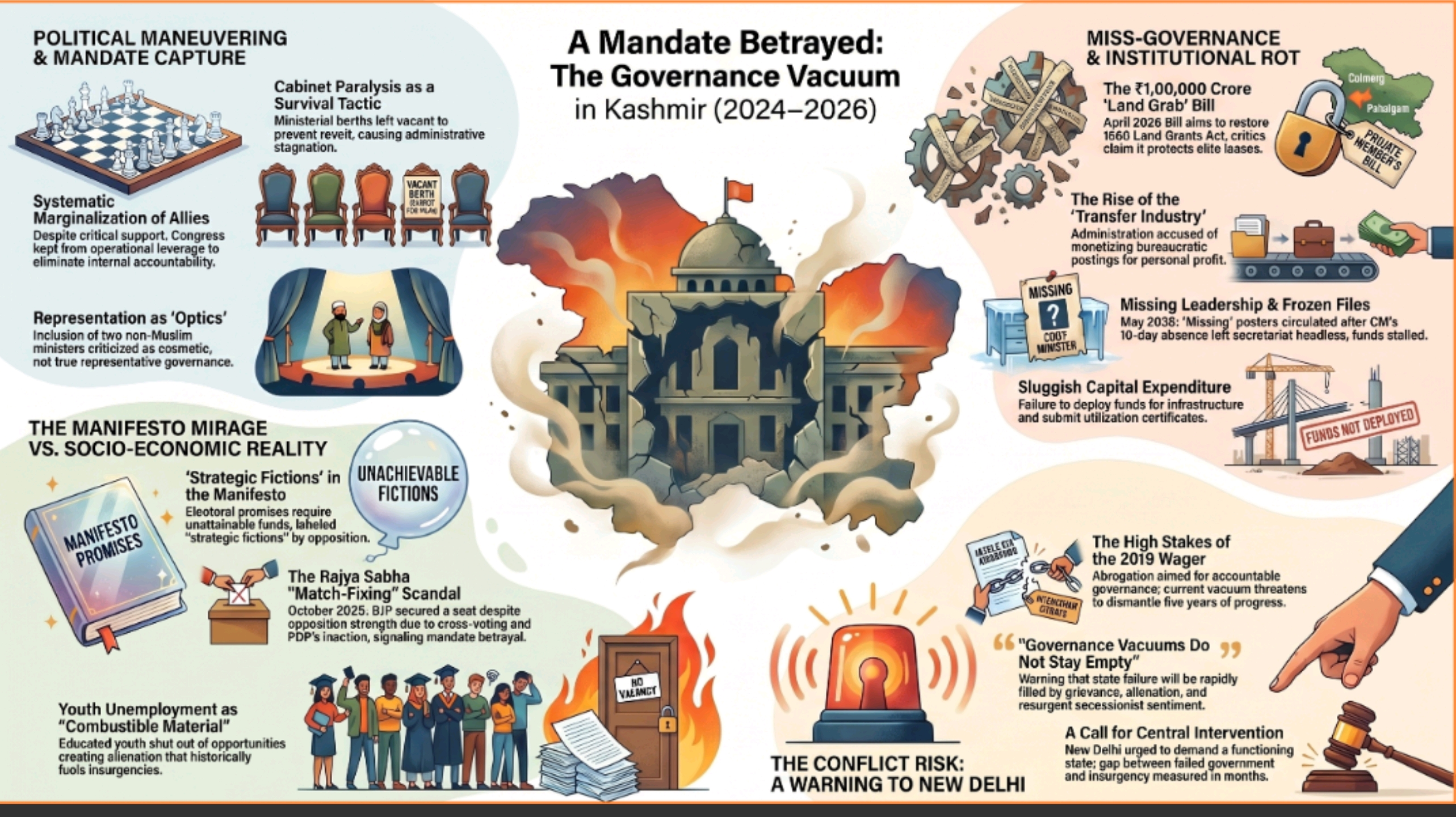
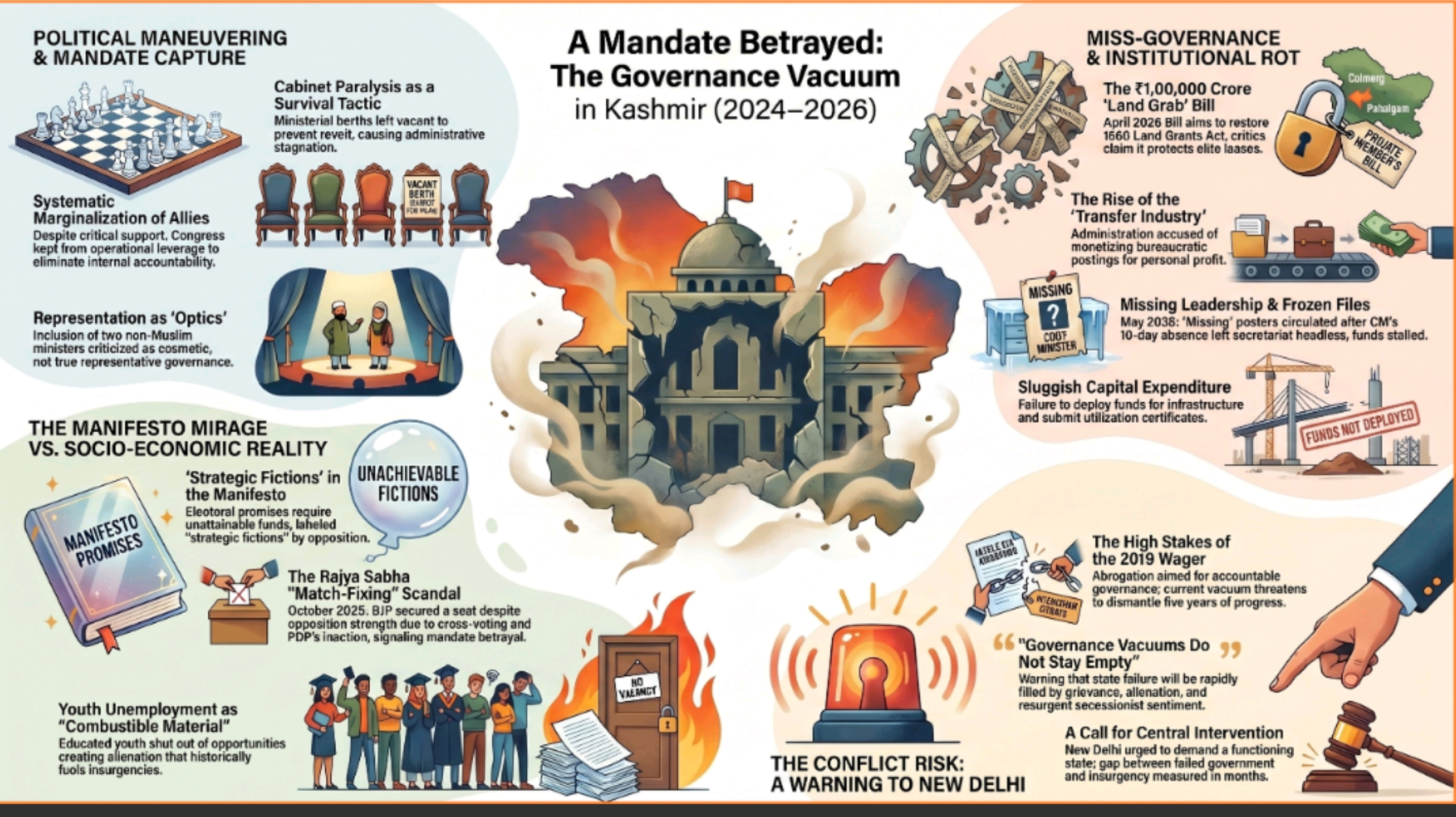
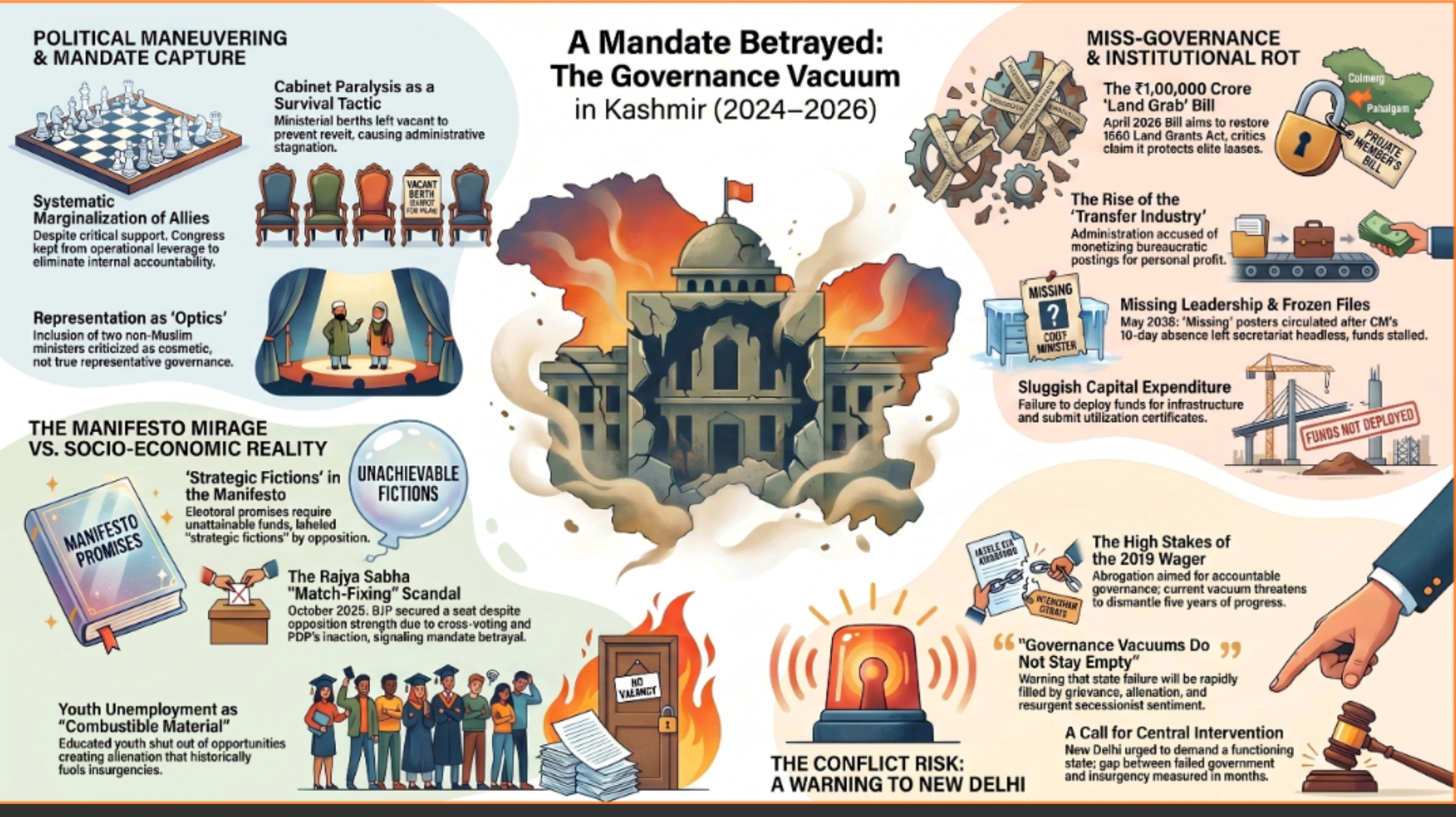
The crucial difference in 2024 is that Omar Abdullah chose to govern alone. Despite the Indian National Congress providing critical seat-sharing support that delivered the NC its commanding majority, Abdullah, upon assuming power, systematically marginalized his pre-poll allies, keeping the Congress leadership placated at the national level while ensuring they held no operational leverage in Srinagar. It was a politically dexterous maneuver, simultaneously maintaining warm equations with BJP in New Delhi while eliminating any internal accountability. To cosmetically address the glaring Jammu-Kashmir divide, Abdullah inducted two non-Muslim ministers from the Jammu division. Representation as optics, however, is not representation as governance.
The Manifesto Mirage: Promises Written in Sand
"You cannot feed a people with the ink of manifestos," opposition leader Sajad Lone of the Peoples Conference remarked bluntly and the numbers vindicate his scorn. If the NC's electoral promises were to be monetized, the financial requirement would run into hundreds of thousands of crores. These were not ambitious targets; they were strategic fictions, expertly sold to a populace desperate enough to buy them.
More damaging still is the cabinet paralysis that has followed. Abdullah has deliberately left ministerial berths vacant, dangling them as carrots before his MLAs to prevent internal revolt. The calculation is cynically transparent: fill the chairs and the disappointed legislators who don't get portfolios will revolt, bringing the government down. Leave them empty, and governance grinds to a halt. As the BJP has pointedly observed, the NC has essentially chosen the paralysis of administration over the risk of political implosion. The people of Kashmir are paying the price of that calculus every single day.
Absent Leaders, Frozen Files and a Transfer Industry
In May 2026, the BJP circulated "Omar Abdullah Missing" posters across social media and the mockery, however partisan, contained a kernel of undeniable truth. The Chief Minister undertook an extended 10-day personal visit outside the Union Territory, leaving the secretariat effectively headless, fund flows stalled, and developmental projects stranded.
This physical absence reflects a deeper institutional rot. The current administration stands credibly accused of running a thriving "transfer industry" a euphemism for the systematic monetization of bureaucratic postings. When the machinery of governance is for sale, the citizens it is meant to serve become its first victims.
Capital expenditure, the money earmarked for roads, hospitals, and infrastructure has seen alarmingly sluggish deployment. Ground reports suggest an administration incapable of even submitting utilization certificates for funds it already possesses, while publicly blaming New Delhi for inadequate financial support. As Winston Churchill once observed: "However beautiful the strategy, you should occasionally look at the results."
The Land Grab, the Legislature and the Super-Elite
In April 2026, the Legislative Assembly witnessed its most revealing moment of the NC tenure. NC legislator Tanvir Sadiq introduced a Private Member's Bill to restore the J&K Land Grants Act of 1960, effectively reversing land-lease rules implemented by the Lieutenant Governor in 2022. Chief Minister Abdullah allowed the bill's introduction without opposition a calculated non-intervention that spoke louder than any endorsement.
Legislator Sajad Lone's response was surgical: "This bill targets the costliest real estate in Kashmir worth over 1,00,000 crores for the sole benefit of the super-elite." He asked the question no NC minister chose to answer: what is this government doing for the poorest Kashmiri fighting daily persecution over two marlas of ancestral land, while it legislates protections for expired hotel leases in Gulmarg and Pahalgam?
The answer, self-evident and damning, is: nothing.
The Rajya Sabha Scandal: Democracy's Quiet Burial
If one episode encapsulates the moral bankruptcy of the current political arrangement in Kashmir, it is the October 2025 Rajya Sabha elections. The opposition bloc possessed the numerical strength to deny the BJP a seat. Instead, the BJP secured it. At least four non-BJP MLAs cross-voted. The PDP, mysteriously, failed to appoint polling agents.
Lone's explosive allegations, backed by RTI data, pointed to one unavoidable conclusion: match-fixing between ostensibly opposed parties. "The people of Kashmir voted for a bulwark against the BJP," he declared, "and their elected representatives sold that mandate to the highest bidder."
In a democracy, betrayal of the electorate is a political sin. In Kashmir, where the faith of ordinary citizens in democratic institutions is not inherited but earned, election by painful election, it is a catastrophe.
The Economic Wasteland Where Youth Go to Lose Hope
Beneath the political theatre lies a devastated human landscape. Youth unemployment in J&K remains deeply entrenched, with thousands of educated young men and women shut out of a stagnant private sector and a frozen public recruitment system. These are not statistics they are the combustible material from which every insurgency in Kashmir's history has drawn its first recruits.
History offers no comfort here. Every generation of alienated Kashmiri youth every young man who found closed doors where opportunity should have been became the social base upon which separatist and militant movements reconstructed themselves. The NC government, in its administrative paralysis, is not merely failing its voters; it is manufacturing the conditions for the next crisis.
New Delhi's Moment of Reckoning
The strategic calculus for New Delhi must be stated plainly: allowing the NC to enjoy the privileges of office while Kashmir's governance collapses is not a neutral act. It is a choice — and a catastrophically short-sighted one.
The Kashmiri people voted in historic numbers in 2024 because they believed, perhaps for the first time in a generation, that democratic participation could deliver tangible relief. If that faith is shattered not by a bullet or a crackdown, but by the mundane, grinding betrayal of corruption, elitism, and empty chairs in a cabinet the resulting alienation will be far harder to reverse than any militancy.
New Delhi dismantled Article 370 to build a new Kashmir. It cannot now be a passive spectator while a feckless government dismantles what five years of painstaking effort constructed.
The people of Jammu and Kashmir do not need another political patron. They need a functioning state. If Omar Abdullah will not provide one, the Centre must find the will and the urgency to demand it.
Because in Kashmir, the space between a failed government and a resurgent insurgency is measured not in miles, but in months.
Saleem Dar is a Kashmiri researcher and political analyst specialising in online content frameworks across the political and socio-economic spectrum. He has worked extensively with multiple organisations on digital narrative-building, policy discourse and the intersection of governance and public communication in conflict-affected regions.
The views expressed in this article are strictly the author's own and do not reflect the positions or policies of any organisation he is affiliated with.

[[comment.comment_text]]