Kashmir: The Land of Knowledge, Faith, and Nationhood

 1 year, 1 month ago
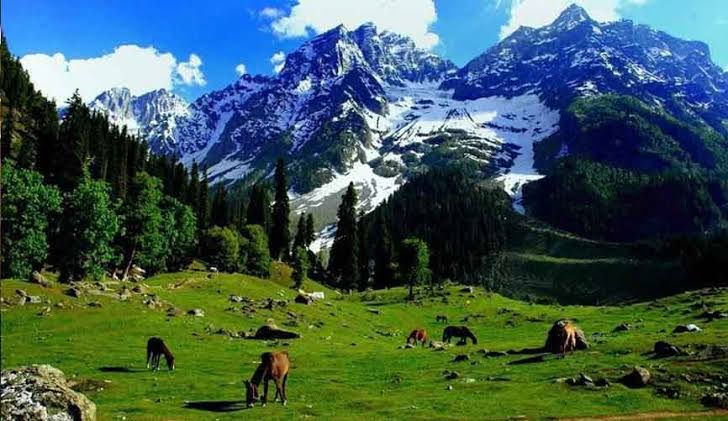
Whenever the name of Kashmir is uttered, the mind immediately paints a picture of snow-clad peaks, lush green meadows, and the shimmering waters of the Dal Lake. The world calls it “paradise on earth.” Yet Kashmir’s true identity extends far beyond its breathtaking beauty. It is the crown of India, the soul of our civilization, and the eternal flame of knowledge and culture that has illuminated Asia for centuries.
The very origins of Kashmir are tied to legend. It is said that Sage Kashyapa drained a vast lake to create the valley, which came to be known as “Kashyap-mar,” later Kashmir. In ancient texts, including the Nilamata Purana (6th–8th century CE), the valley is described as a sacred land. It was also known as Sharada Desh, named after the goddess of learning, Sharada, whose temple and university once stood in present-day Neelum Valley (now in Pakistan-occupied Kashmir). Archaeological evidence suggests that Sharada Peeth flourished as a learning center between the 6th and 12th centuries CE, attracting scholars from across India and Central Asia.
From this land emerged some of India’s most celebrated intellectuals. Acharya Abhinavagupta (c. 950–1016 CE), philosopher and aesthete, authored over 40 works, including the monumental Tantraloka, influencing not only Shaivism but also Indian aesthetics. Kalhana (12th century) composed the Rajatarangini, often regarded as South Asia’s first historical chronicle, covering Kashmir’s history from mythical times to his own era. Anandavardhana (9th century), through Dhvanyaloka, revolutionized literary theory, while Kshemendra (11th century) became known for his satirical works like Samaya Matrika, critiquing social evils of his time.
Equally significant were Kashmir’s saints and poets. Lalleshwari (Lal Ded) in the 14th century wrote over 200 vakhs (poetic verses) that blended Shaiva philosophy with universal spirituality, inspiring both Hindus and Muslims. Sheikh Noor-ud-din Rishi (1377–1438), the founder of the Rishi order, carried forward this syncretic spirit, emphasizing simplicity, harmony, and devotion. This shared heritage of saints and sufis shaped the “Kashmiriyat” ethos of pluralism.
Kashmir was not just an intellectual hub—it was also a cultural bridge. Sanskrit, Persian, and Kashmiri literature flourished here side by side. Kalidasa, the great classical poet, described the region’s beauty in his Raghuvamsa. Persian scholars like Ghani Kashmiri (17th century) carried its literary fame beyond India. The valley became an epicenter of Shaivism, Buddhism, and Sufism at different points in history, a rare example of spiritual coexistence. Even Buddhism, which spread to Tibet and Central Asia, carried Kashmiri influence, as Kashmiri monks helped in the translation of Sanskrit texts into Tibetan during the 7th–10th centuries CE.
In terms of scale, Kashmir’s intellectual contribution is remarkable. By the 12th century, Sharada Peeth was counted among the three great universities of ancient India—alongside Nalanda and Takshashila. Scholars like Kumārajīva (4th century), though born in Central Asia, carried Kashmiri learning to China, spreading Buddhism. Modern historians note that Kashmiri pandits produced an unparalleled body of Sanskrit commentaries between the 9th and 12th centuries, making the valley a backbone of Indian philosophy.
Culturally, Kashmir has always been a crucible of harmony. The “Ganga-Jamuni tehzeeb” that we associate with North India found one of its strongest roots here. Kashmiri music—Sufiana Kalam—is a blend of Persian and Indian traditions. Its handicrafts, from Pashmina shawls to papier-mâché art, sustain lakhs of artisans even today. The valley’s famed saffron, cultivated in Pampore, is among the world’s finest, recently given a Geographical Indication (GI) tag.
Yet in modern times, Kashmir is often reduced to politics and conflict. Since 1947, the region has witnessed wars, insurgency, and displacement, including the tragic exodus of Kashmiri Pandits in the 1990s. But to view Kashmir only through this lens is to deny its deeper essence. Every mountain and shrine continues to testify to India’s timeless heritage. The Shankaracharya Hill in Srinagar recalls Adi Shankaracharya’s 8th-century visit. The Amarnath cave, with its natural ice-linga, still attracts lakhs of pilgrims annually. And on the banks of the Jhelum, Lal Ded’s verses and the Rishi-Sufi songs remain alive in collective memory.
Today, Jammu and Kashmir, with a population of nearly 1.25 crore (Census 2011), remains central to India’s identity.
Tourism is rebounding—over 1.88 crore tourists visited in 2023, the highest ever recorded. Education, too, is being revitalized, with new universities and skill centers being set up. But more than economics or politics, it is Kashmir’s civilizational role that needs to be remembered.
Kashmir is more than geography, more than borders—it is the embodiment of India’s soul. Those who dream of separating Kashmir from India are, in reality, dreaming of dividing the very essence of India. But a soul cannot be divided. What is needed is not just political dialogue, but a national effort to reclaim Kashmir’s true identity—as a land of knowledge, faith, and nationhood.
Kashmir is India’s crown, India’s soul. From this sacred land have flowed streams of philosophy, poetry, and devotion. Here saints and sufis raised their voices together, and from here spread the light of national consciousness. To cherish this truth is to affirm that India’s crown is not merely a territory, but the living spirit that makes the nation whole. And this spirit, eternal and indivisible, proclaims with certainty: India’s soul cannot be divided.
(Author is a Professor and Director at the Centre for Professional Development in Higher Education, University of Delhi)








[[comment.comment_text]]