Beyond Marks

 5 months, 2 weeks ago
Every year, as examination results are declared across India, a predictable emotional landscape emerges. Some households celebrate extraordinary scores with pride, while others fall into silence, disappointment, or anxiety. Yet beneath both reactions lies a deeper and more complex reality: even success often feels incomplete, and failure is experienced as a lasting stigma. The intense focus on marks has transformed education into a high-pressure system where performance frequently overshadows learning. This recurring cycle compels a critical reassessment—has education in India drifted away from its core purpose?
At its foundation, education in India was never designed as a narrow, result-oriented exercise. Ancient Indian thought treated knowledge as the most refined form of human pursuit—one that shaped intellect, ethics, and life itself. Texts from the Vedic and Upanishadic periods positioned education as a pathway not only to material success but also to moral and spiritual fulfillment. Institutions like Takshashila and Nalanda were not merely centers of instruction; they were hubs of intellectual exchange where subjects ranging from astronomy and medicine to philosophy and governance were taught in an integrated manner. This multidisciplinary tradition highlights that India’s original education model was broad, inclusive, and deeply connected to real-world understanding.
In contrast, the contemporary system reflects a significant shift in priorities. Over the past few decades, education has increasingly become a mechanism for economic mobility. While this transition is understandable in a developing economy, it has also led to an excessive emphasis on examinations as the primary indicator of success. The expansion of central boards such as CBSE and ICSE, along with numerous state boards, has standardized curricula and improved access. However, this standardization has also narrowed the definition of achievement, reducing it largely to numerical scores.
The scale of India’s education system adds another layer of complexity. According to government estimates, India has over 250 million school-going students, making it one of the largest education systems in the world. Each year, millions of students appear for board examinations—Class 10 and Class 12 results alone affect over 30 million candidates annually. In such a vast system, standardized evaluation becomes administratively convenient. Yet, convenience does not necessarily translate into effectiveness. A system designed to assess millions uniformly often struggles to accommodate individual differences in learning styles, interests, and capabilities.
The consequences of this approach are increasingly visible. Surveys and studies have repeatedly indicated rising levels of stress among students, particularly in secondary and senior secondary classes. Academic pressure, combined with parental expectations and peer competition, creates a high-stakes environment. In extreme cases, this has contributed to incidents of student suicides—an issue that has become a matter of national concern. The problem is not limited to those who fail; even high achievers often report anxiety, burnout, and a persistent fear of underperformance.
The paradox is striking: a system intended to empower young minds is, in many cases, becoming a source of distress. This raises questions about the underlying evaluation framework. Marks, by design, are a limited metric—they capture performance in a specific context but fail to measure creativity, critical thinking, emotional intelligence, or resilience. Yet, these are precisely the qualities required in an increasingly complex and unpredictable world.
Recognizing these limitations, policymakers have attempted to introduce reforms. The National Education Policy (NEP) 2020 represents one of the most comprehensive efforts in recent years to reimagine education in India. It proposes a shift from rote learning to conceptual understanding, from rigid streams to multidisciplinary flexibility, and from summative assessments to continuous evaluation. The policy also emphasizes foundational literacy, early childhood education, and the integration of vocational skills.
However, the gap between policy and practice remains significant. Implementation varies across states and institutions, often constrained by infrastructural limitations, teacher training gaps, and administrative inertia. While some schools have begun adopting innovative teaching methods, many continue to operate within traditional frameworks centered on textbooks and examinations. This uneven progress highlights that reform in education is not merely about policy design but also about systemic execution.
One of the most critical yet under-addressed aspects of the current system is mental health. Despite growing awareness, most schools in India lack structured counseling mechanisms. Students dealing with stress, anxiety, or academic pressure often have limited access to professional support. In a system where performance is constantly evaluated, the absence of emotional support structures creates a significant vulnerability. Integrating mental health services into educational institutions is no longer optional—it is essential.
Equally important is the need to redefine the content and purpose of education. The 21st century demands a skill set that goes beyond traditional academic knowledge. Digital literacy, problem-solving, communication, and adaptability have become fundamental competencies. According to various industry reports, a significant proportion of graduates in India are considered unemployable due to a mismatch between academic training and market requirements. This disconnect underscores the need for skill-based education.
Vocational training, once considered secondary, must be integrated into mainstream curricula. Fields such as information technology, renewable energy, agriculture, and entrepreneurship offer significant opportunities, particularly in a country with a large युवा population. Early exposure to these domains can help students develop practical skills and reduce dependence on limited white-collar job opportunities.
Another structural issue is the disparity between urban and rural education. While urban schools often have access to better infrastructure, qualified teachers, and digital resources, rural institutions frequently struggle with basic facilities. According to various educational surveys, learning outcomes in rural areas consistently lag behind urban counterparts. The digital divide further exacerbates this gap. Although online education expanded rapidly during the COVID-19 pandemic, its benefits were unevenly distributed, leaving many students without access to devices or reliable internet connectivity.
Addressing this inequality requires targeted interventions. Investment in infrastructure, teacher training, and digital access must be prioritized. At the same time, localized approaches to education—taking into account regional languages, cultural contexts, and economic realities—can make learning more relevant and effective.
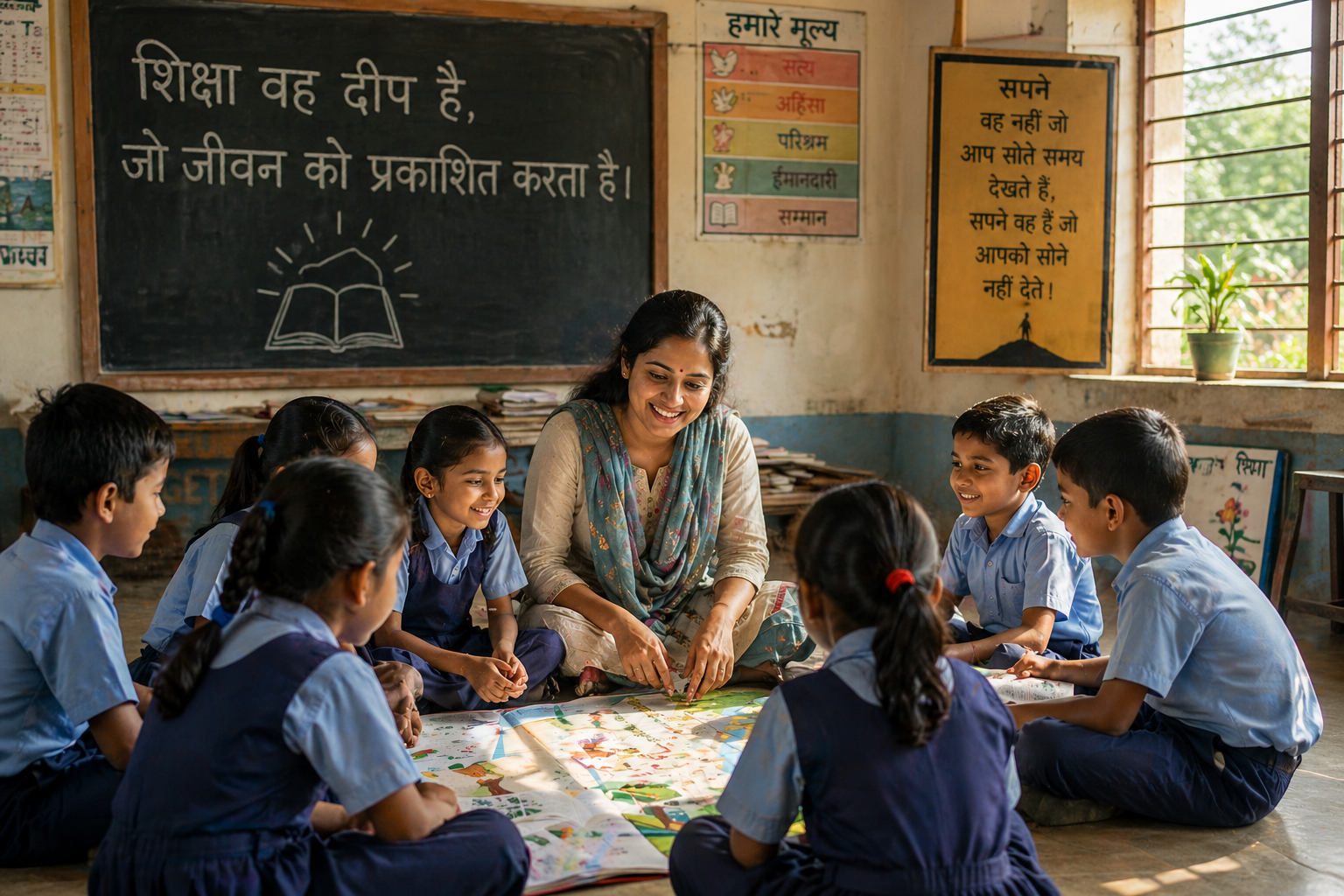
The role of teachers in this ecosystem is critical. Teachers are not merely transmitters of information; they are facilitators of learning and mentors who shape students’ perspectives. However, they often operate under constraints—large class sizes, administrative responsibilities, and limited opportunities for professional development. Strengthening teacher training programs and providing continuous support can significantly improve educational outcomes.
Families, too, play a decisive role. In many cases, parental expectations contribute to the pressure experienced by students. The aspiration for upward mobility often translates into an intense focus on academic success, sometimes at the cost of the child’s well-being. A shift in mindset is necessary—one that values effort, learning, and individual strengths over mere scores.
Beyond the immediate ecosystem, broader societal factors also influence education. Today’s students are growing up in a world marked by rapid technological change, environmental challenges, and geopolitical uncertainties. Issues such as climate change, biodiversity loss, and global conflicts are no longer abstract concepts; they form part of the lived reality. Exposure to such complexities can impact young minds, making it essential for education systems to build resilience and critical thinking.
In this context, value-based education assumes renewed importance. Ethical reasoning, social responsibility, and cultural awareness must be integrated into the curriculum. India’s traditional knowledge systems offer valuable insights in this regard. The emphasis on harmony, sustainability, and collective well-being can complement modern scientific education, creating a more balanced approach.
Importantly, the question of accountability must be addressed. Educational outcomes are not the responsibility of students alone. Teachers, institutions, policymakers, and society at large all contribute to the system. When students underperform, it reflects not just individual shortcomings but also systemic gaps. A more balanced approach would involve shared responsibility and collaborative problem-solving.
The issue of assessment also requires reconsideration. Continuous and comprehensive evaluation, project-based learning, and practical assessments can provide a more accurate picture of a student’s abilities. Several countries have already adopted such models, reducing the emphasis on high-stakes examinations. While India’s scale presents unique challenges, pilot programs and phased implementation can pave the way for broader reforms.
Despite these challenges, there are also positive developments. The increasing use of technology in education—through digital platforms, online courses, and interactive tools—has the potential to enhance learning experiences. Initiatives aimed at improving foundational literacy and numeracy are beginning to show results in some regions. Startups in the education technology (edtech) sector are introducing innovative solutions, although their long-term impact remains to be fully assessed.
Ultimately, the central question remains unchanged: what should education achieve? If it continues to be defined primarily by marks, it risks becoming a mechanical process that prioritizes outcomes over understanding. However, if it evolves to nurture curiosity, creativity, and character, it can become a transformative force.
India’s historical experience provides both inspiration and direction. The country once led the world in knowledge production, not because of standardized tests, but because of a culture that valued inquiry and learning. Reconnecting with this tradition does not mean rejecting modernity; rather, it involves integrating timeless principles with contemporary needs.
The way demands a coherent, multi-dimensional strategy rather than isolated interventions. Policy reform, while necessary, is insufficient unless it is reinforced by deep institutional transformation at the school and university levels. Curriculum redesign must move beyond theoretical intent and be operationalized through sustained teacher training, equipping educators with the pedagogical tools required for experiential, student-centric learning.
Equally critical is the integration of mental health support as a core component of the education system, not an auxiliary service. Structured counseling, early identification of stress indicators, and a supportive school environment must become standard practice. At the same time, skill development frameworks need to be systematically aligned with evolving economic realities, ensuring that education translates into employability, entrepreneurship, and adaptability in a rapidly changing job market.
However, the most fundamental shift must occur at the societal level. The prevailing perception of education as a narrow race for marks and credentials must give way to a broader understanding of learning as a lifelong, holistic process. Without this attitudinal transformation, even the most well-designed reforms risk remaining superficial.
Education, at its best, is not a race but a process—a continuous journey of discovery and growth. Marks may measure a moment, but they cannot define a life. Rebalancing the system to reflect this understanding is not merely an educational imperative; it is a societal necessity.




[[comment.comment_text]]