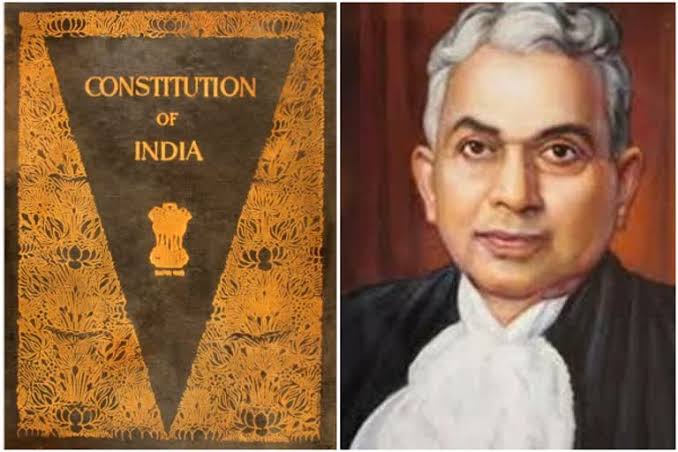
Sir B.N. Rau: The Mastermind Behind the Drafting of India’s Constitution

 1 year, 1 month ago
Sir Benegal Narsing Rau, remembered as the unsung architect of the Indian Constitution, was born on 26 February 1887 in Karkal, Mangalore (then part of the Madras Presidency) into a scholarly Saraswat Brahmin family. His father, Benegal Raghavendra Rau, a renowned physician, instilled in him a deep love for education and discipline. From his earliest years, Rau’s brilliance was evident—he topped the Madras Presidency in school examinations and in 1905 secured first class in English, Sanskrit, and Physics during his graduation. This achievement won him a scholarship to Trinity College, Cambridge, where he pursued higher studies. In 1909, he cleared the prestigious Indian Civil Services (ICS) examination, the only Indian in his batch of fifty candidates. A polyglot and scholar, Rau mastered Sanskrit, English, French, German, and Latin, while excelling in Physics, Mathematics, and Law.
Rau’s administrative career was as distinguished as his academic record. Beginning in the Indian Civil Service in Madras, he quickly rose to positions of great influence. He served as Judge of the Calcutta High Court, Prime Minister of Jammu and Kashmir between 1944 and 1945, and later as Judge of the International Court of Justice at The Hague in 1952, becoming the first Indian to hold that post. He also represented India as its Permanent Representative to the United Nations. In Burma, he was instrumental in drafting the Burmese Constitution in 1947, and in India, his expertise shaped the Government of India Act, 1935, a landmark document that foreshadowed the constitutional framework of independent India.
Even before the Constituent Assembly convened, Rau was appointed Constitutional Advisor by Viceroy Lord Wavell in July 1946. Remarkably, he accepted this role on an honorary basis, declining any government salary while other members drew regular pay. In the same month, Jawaharlal Nehru formed the Constitution Expert Committee, but when it came to the actual preparation of constitutional material, it was Rau whom Nehru entrusted with the monumental responsibility. To assist Assembly members, Rau prepared the Constitutional Precedent Series—three volumes published between September 1946 and 1947—providing detailed references to global constitutional practices. His scholarship was extraordinary: he studied the constitutions of 60 countries, visited 15 nations, and consulted eminent jurists including Justice Felix Frankfurter and Judge Learned Hand in the United States, as well as experts in Canada, Ireland, the UK, and Australia. These consultations enriched his understanding of federalism, judicial review, and fundamental rights, which became cornerstones of India’s Constitution.
Drawing upon sources such as the Nehru Report of 1928, the Government of India Act of 1935, committee reports of the Constituent Assembly, and his comparative study of global constitutions, Rau prepared the original draft of the Indian Constitution. This draft contained 243 articles and 13 schedules and laid down the fundamental framework of governance. His 1946–47 work, India’s Constitution in the Making, remains a testimony to his meticulous comparative approach and legal acumen.
On 29 August 1947, nine months after the Constituent Assembly began its work, the Drafting Committee was established with Dr. B.R. Ambedkar as its Chairman. Rau’s draft became the foundation upon which the Committee worked, debated, and introduced refinements. T.T. Krishnamachari candidly admitted in the Assembly that much of the drafting work had already been done by Rau and that the Committee’s role was primarily to improve and finalize it. Syed Mohammad Sadullah went further, saying that the Drafting Committee’s role was essentially to “clothe the child” already created by Rau. While Ambedkar’s leadership, presentation, and defense of the draft were invaluable, the intellectual foundation and original framework had been laid by Rau. Contemporary voices such as Rajendra Prasad, Nehru, and K.M. Munshi openly acknowledged his role, with Rajendra Prasad declaring, “We are all indebted to Sir B.N. Rau. His scholarship, clarity and neutral approach gave direction to the process of constitution making.”
After his crucial contribution to the Constitution, Rau went on to represent India at the United Nations and later served on the International Court of Justice at The Hague. His life came to an end on 30 November 1953 in New York while serving as India’s Permanent Representative to the UN. His death was mourned deeply in India and abroad. Prime Minister Nehru described him as “one of the highest intellectual and constitutional minds of India,” while The New York Times hailed him as the “Mastermind of the Indian Constitution.”
Rau’s role in constitution-making has sometimes been overshadowed by political narratives, but his contribution remains undeniable. If the Indian Constitution is a great tree, then Rau provided the seed, soil, and nourishment from which it grew.
His tireless scholarship, comparative wisdom, and commitment to national service shaped the document that governs the world’s largest democracy. As Justice H.R. Khanna once said, “The work of Sir B.N. Rau is a pillar in the history of Indian jurisprudence. His contribution to the process of constitution making is irrefutable and highly respected.”
In every sense, Sir B.N. Rau remains the real maker of the Indian Constitution—a visionary whose intellectual legacy endures in every article, every principle, and every democratic value that India cherishes.
(Author, a commentator on legal and constitutional issues, holds a LL.M degree.)






[[comment.comment_text]]