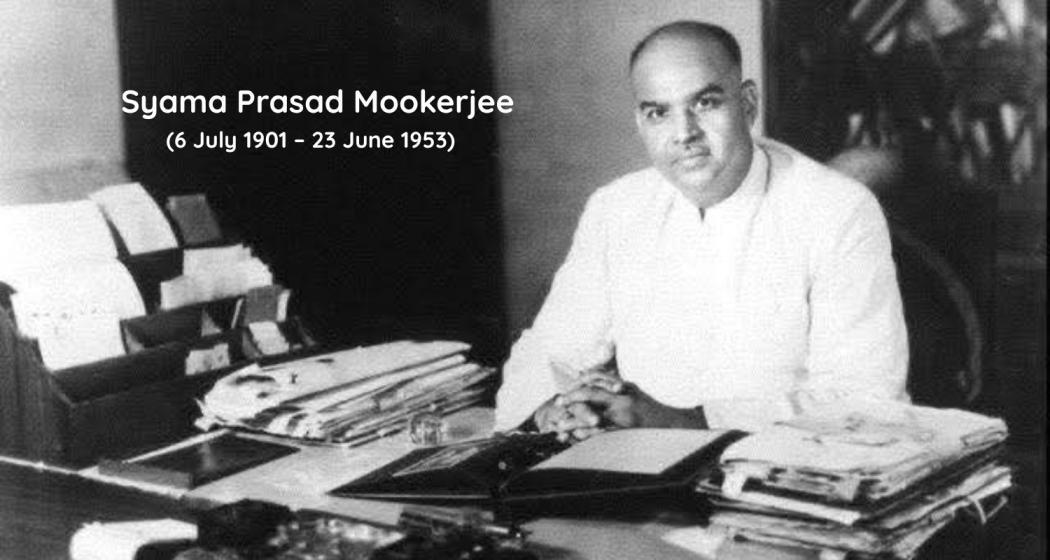
Dr. Shyama Prasad Mukherjee: The Paradoxical Pioneer of Hindu Nationalism

 1 year, 2 months ago
Dr. Shyama Prasad Mukherjee, a towering figure in India’s political history, is revered as the ideological architect of the Bharatiya Janata Party (BJP) through his founding of the Bharatiya Jana Sangh. His life, marked by staunch Hindu nationalism, pragmatic alliances, and a mysterious death in a Kashmir prison, encapsulates the contradictions of a man navigating the turbulent currents of colonial and post-independence India. From opposing the Quit India Movement to aligning with the Muslim League, and from serving in Nehru’s cabinet to resigning over the Hindu Code Bill, Mukherjee’s legacy reflects the tensions between ideological purity and political expediency.
We will examine here his multifaceted contributions, controversies, and enduring influence on India’s right-wing politics marking the beginning of his 125th birth anniversary celebration.
Early Life and Political Ascendancy
Born on July 6, 1901, in Calcutta to a distinguished Bengali family, Shyama Prasad Mukherjee was shaped by an elite intellectual environment. His father, Sir Ashutosh Mukherjee, a renowned jurist and vice-chancellor of Calcutta University, instilled in him a commitment to scholarship and public service. A barrister by training, Mukherjee entered politics through the Hindu Mahasabha in the 1930s, rising as a vocal advocate for Hindu unity amid the communal tensions of colonial India. Under leaders like V.D. Savarkar, the Mahasabha sought to counter the Muslim League’s growing influence and British policies perceived as marginalizing Hindus. Mukherjee’s oratory and organizational prowess positioned him as a key figure in Bengal’s volatile political landscape.
Opposing Quit India: A Controversial Stance
In August 1942, as the Indian National Congress launched the Quit India Movement, demanding immediate independence from British rule, Mukherjee, then a senior Hindu Mahasabha leader and Finance Minister in Bengal’s provincial government, took a starkly divergent path. In a letter dated July 26, 1942, to the Governor of Bengal, he urged the colonial administration to “take the strongest possible measures to repress the Congress revolt” and “crush the movement,” arguing it would destabilize India and undermine the Allied war effort during World War II.
This stance drew sharp criticism from nationalists, who viewed it as a betrayal of the independence struggle. Critics argue that Mukherjee’s alignment with British interests prioritized his ideological rivalry with Congress over national unity. Supporters, however, defend his position as pragmatic, citing the need to maintain stability amid global conflict and communal strife. This episode remains a contentious chapter, complicating Mukherjee’s image as a patriot.
The Bengal Coalition: Pragmatism Over Ideology
Equally controversial was Mukherjee’s decision in 1941 to join a coalition government in Bengal under Fazlul Haq’s Progressive Coalition, alongside the Muslim League, a party he ideologically opposed for its advocacy of Muslim separatism. As Finance Minister, Mukherjee sought to counter Congress’s dominance and protect Hindu interests in a Muslim-majority province. This alliance, however, raised questions about his commitment to Hindu nationalism, as it appeared to contradict his opposition to the League’s two-nation theory.
Supporters argue that this was a strategic necessity to ensure Hindu representation, while critics see it as an opportunistic move that exposed ideological inconsistencies.
The coalition collapsed in 1943 amid the Bengal famine and rising communal tensions, underscoring the fragility of such partnerships. Mukherjee’s Bengal years highlight a willingness to prioritize political expediency over ideological purity, a trait that both defined and complicated his legacy.
Nehru’s Cabinet and the Hindu Code Bill Rift
Following India’s independence in 1947, Mukherjee was appointed Minister of Industry and Supply in Jawaharlal Nehru’s first cabinet, a surprising inclusion given his Hindu nationalist credentials. This reflected Nehru’s attempt to foster national reconciliation by integrating diverse voices.
However, tensions soon surfaced, culminating in Mukherjee’s resignation in 1950 over the Hindu Code Bill, a reform championed by Nehru and Dr. B.R. Ambedkar to modernize Hindu personal laws, granting women rights to divorce and inheritance.
Mukherjee opposed the bill, arguing it undermined traditional Hindu family structures and religious values. His resignation was both a protest against perceived secular overreach and a strategic move to consolidate conservative Hindu support. Critics view his stance as regressive, opposing gender equality, while supporters frame it as a defense of cultural sovereignty. This rift marked a definitive break with Nehru’s pluralistic vision, setting the stage for Mukherjee’s next political venture.
Founding the Bharatiya Jana Sangh
In 1951, disillusioned with Congress, Mukherjee founded the Bharatiya Jana Sangh (BJS), with ideological ties to the Rashtriya Swayamsevak Sangh (RSS). The BJS advocated for a unified India rooted in Hindu cultural values, opposing Congress’s perceived minority appeasement and socialist policies. Its platform emphasized national integration, economic self-reliance, a uniform civil code, and issues like cow protection and Hindi as the national language.
Under Mukherjee’s leadership, the BJS gained traction among urban Hindus and conservative sections, laying the ideological foundation for the BJP, established in 1980. Though marginal in its early years, the Jana Sangh’s vision of cultural nationalism, including the abolition of Article 370, foreshadowed key BJP policies, notably the 2019 revocation of Kashmir’s special status.
The Kashmir Protest and ‘Martyrdom’!
Mukherjee’s final act was his 1953 campaign against Article 370, which granted Jammu and Kashmir a separate constitution, flag, and autonomy. Viewing this as a threat to India’s unity, he launched a protest, famously declaring, “Ek desh mein do vidhan, do pradhan, do nishan nahi chalenge” (One nation cannot have two constitutions, two prime ministers, two flags). Defying the permit system to enter Kashmir, he was arrested and detained in a Srinagar prison.
On June 23, 1953, Mukherjee died in custody under mysterious circumstances, officially attributed to a heart attack. The lack of transparency fueled conspiracy theories of negligence or foul play by the Nehru government and Kashmir authorities, cementing his martyrdom among Hindu nationalists. His death galvanized the Jana Sangh and amplified demands for Kashmir’s integration, a cause that resonated decades later with the BJP’s 2019 policy.
Legacy: A Polarizing Icon
Mukherjee’s legacy is a study in contradictions: a Hindu nationalist who allied with the Muslim League, a patriot who supported British suppression of Quit India, and a cabinet minister who dissented over ideological differences. His founding of the Jana Sangh provided a coherent framework for Hindu nationalism, shaping the BJP’s dominance in contemporary Indian politics. Statues, roads, and institutions bear his name, and his portrait hangs in Parliament, reflecting his enduring influence.
Yet, his life raises critical questions about the balance between ideological commitment and political pragmatism. His opposition to Quit India and coalition with the Muslim League suggest a strategic flexibility, while his stands on the Hindu Code Bill and Kashmir reflect uncompromising conviction. Critics argue that his majoritarian politics, cloaked in nationalism, pose challenges to India’s pluralistic fabric, while supporters view him as a visionary who prioritized cultural unity.
Today, as the BJP invokes Mukherjee’s name to champion Hindu pride and national integration, his legacy fuels debates about secularism, federalism, and inclusivity. His death in Kashmir remains a rallying cry for the right, but it also underscores the complexities of India’s diverse polity. Mukherjee’s life, marked by conviction and controversy, continues to shape India’s political discourse, embodying the tensions between unity and diversity in a pluralistic nation.
(Author is a former member of the history faculty at St. Xavier’s College, Mumbai. Views are personal.)







[[comment.comment_text]]