Dr. Sachchidananda Sinha: The Architect of Modern Bihar

 2 hours ago
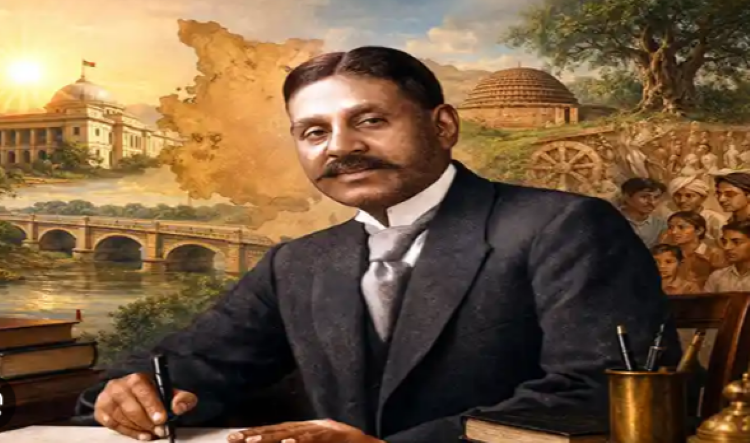
When history records the story of India’s march toward independence and nation-building, a few names shine bright, while others—equally monumental—fade into the quiet background. Dr. Sachchidananda Sinha belongs to the latter. A brilliant lawyer, pioneering journalist, visionary educationist, and statesman, Dr. Sinha’s legacy is woven into the very fabric of modern India and the creation of Bihar. Yet, the memory of this titan remains largely uncelebrated in public memory.
Early Years and the Spark of Freedom
Born in 1871 in the village of Murar in Bihar’s Buxar district, Sachchidananda Sinha grew up in an atmosphere shaped by the aftermath of the 1857 Revolt. His father, Ramayad Sinha, was a man of principles who served as a lawyer in Varanasi and later settled in Arrah. Sinha’s fiery spirit manifested early in life. While studying at Arrah District School, he led a student protest against the headmaster's oppressive behavior, resulting in the expulsion of one hundred students, including himself. Undeterred by this setback, he completed his matriculation from T.K. Ghosh Academy in Patna.
His journey took a major turn when he decided to sail to England in 1889 to study law at the Middle Temple. Defying societal norms that viewed sea travel as defiling, he became one of the first Bihari Hindus to pursue higher education in London. In England, he actively engaged with the British Committee of the Indian National Congress and campaigned for Dadabhai Naoroji’s parliamentary election, laying the groundwork for his lifelong devotion to the national cause.
The Champion of Bihari Identity
Upon returning to India in 1893, Dr. Sinha enrolled as an advocate, practicing at the Calcutta and Allahabad High Courts. However, a deeper grievance continuously troubled him: Bihar lacked an independent identity, remaining merged within the large Bengal Presidency. Driven by a desire to give his homeland a distinct voice, Dr. Sinha, alongside journalist and poet Mahesh Narayan, launched The Bihar Times in 1894.
Through high-caliber journalism and relentless political advocacy, he mobilized public opinion across the region. He carried this crusade to the Imperial Legislative Council, culminating in the historic announcement at the 1911 Delhi Durbar that carved out Bihar as a separate province. On March 22, 1912, the formal notification for Bihar’s creation was issued—a date now commemorated annually as Bihar Diwas. Through his relentless vision, Dr. Sinha earned his place as the architect of modern Bihar and the pioneer of the Bihari Renaissance.
A Giant of Indian Journalism
Dr. Sinha recognized early on that a free nation needed a powerful, independent press. Over five decades, he founded, edited, and nurtured publications that shaped Indian political thought and gave momentum to the national movement. The Bihar Times, established in 1894, served as the foundational voice for the movement demanding statehood for Bihar. Shortly after, in 1900, he took over Kayasth Samachar and transformed it into The Hindustan Review, a monthly journal that became a nationally renowned forum for intellectual discourse under his eighteen-year editorship.
His journalistic ambition reached further with The Leader, launched from Allahabad in 1909 with veteran editor C.Y. Chintamani at the helm, growing into one of the most influential nationalist newspapers of its era. Later, in 1918, he established The Searchlight in Patna alongside leaders like Dr. Rajendra Prasad and Hasan Imam. This publication evolved into a major daily newspaper that served as a vital mouthpiece for the Indian freedom struggle throughout the twentieth century.
Building Intellectual Foundations and the Sinha Library
Believing that real emancipation comes through knowledge, Dr. Sinha dedicated his wealth and personal collections to promoting literacy and scholarship across society. Alongside his wife, Radhika Sinha—a remarkably generous woman who donated vast sums to educational causes—he established the Radhika Sinha Institute and the Sinha Library in Patna. Inaugurated by Governor Henry Wheeler, the library housed tens of thousands of rare volumes, many personally annotated by Dr. Sinha himself.
A true polyglot fluent in Hindi, English, Urdu, and Persian, Dr. Sinha wrote insightful literary critiques, including a celebrated study on the poetry of Allama Iqbal. Yet, despite his high erudition, he remained deeply rooted in his native culture, famously insisting on speaking in Bhojpuri at home and with visitors.
A Statesman in the Halls of Power
Dr. Sinha’s legal acumen and administrative talent saw him rise to prominent constitutional roles throughout his public life. He served as the Vice-Chancellor of Patna University for four consecutive terms starting in 1936, transforming it into a premier center of higher learning. His political career was marked by historic achievements: he was elected the first Deputy President of the Central Legislative Assembly in 1921, served as the Finance Member of the Executive Council of Bihar and Orissa, and represented Patna University in the Bihar Legislative Assembly.
The pinnacle of his constitutional journey came in December 1946. As the oldest and most respected member of the Constituent Assembly, Dr. Sachchidananda Sinha was chosen as its first interim President to preside over its inaugural sessions. Though failing health prevented him from being in New Delhi during the final signing ceremony, the original draft of the Indian Constitution was flown to Patna so he could sign it on February 14, 1950.
An Enduring Legacy Overshadowed by Time
Dr. Sachchidananda Sinha passed away on March 6, 1950. The physical footprint of his generosity remains visible across Bihar: the lands he donated in Patna host the Bihar Legislative Assembly, Patna Airport, and the Bihar School Examination Board.
Yet, as decades have passed, public memory of his immense contribution has quietly faded. His life was a rare blend of fiercely independent journalism, profound constitutional scholarship, passionate social reform, and selfless philanthropy. Remembering Dr. Sinha is not merely an exercise in historical reflection—it is paying a long-overdue debt to a leader who gave Bihar its identity and helped lay the constitutional foundation of modern India.
(Author, a PhD from School of International Studies, JNU, is a senior TEW editorial adviser and columnist.)


[[comment.comment_text]]