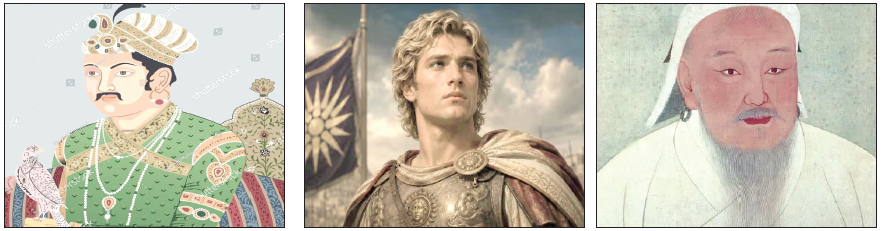
Alexander the Great, Genghis Khan and Akbar the Great
 2 days, 2 hours ago
Three Conquerors, Three Worlds
History remembers Alexander III of Macedon (356–323 BCE), Genghis Khan (c. 1162–1227 CE) and the Mughal emperor Jalal al-Din Muhammad Akbar (1542–1605) as three extraordinary rulers whose military achievements transformed the political geography of their respective ages. They lived in different centuries, belonged to different civilisations and governed through different institutions. Yet each possessed an uncommon capacity to command armies, overcome established powers, absorb diverse peoples into an expanding empire and leave a political legacy extending far beyond his lifetime.
Alexander shattered the power of the Achaemenid Persian Empire and carried Macedonian-Greek influence into Egypt and Central Asia, reaching north-western India. Genghis Khan united the Mongol tribes and established the foundations of an empire that expanded across much of Eurasia under his successors. Akbar consolidated Mughal power in the Indian subcontinent and developed an imperial system that brought diverse religious, linguistic and regional communities into a common political framework.
Their greatness cannot be measured solely by the territories they conquered. It must also be assessed through their methods of warfare, administrative innovations, treatment of conquered populations, relationship with religion, patronage of learning and capacity to convert military victory into political authority.
All three demonstrated courage and ambition. All three understood that successful conquest required more than individual bravery: it demanded disciplined armies, capable commanders, intelligence, logistical preparation and the management of competing interests. Nevertheless, they were not identical models of enlightened government. Their reigns also witnessed violence, coercion, rebellion and severe punishment. A historically defensible comparison must acknowledge both their achievements and limitations.
The most important distinction is that Alexander was principally a conqueror of the ancient world whose empire fragmented after his death; Genghis Khan created a durable imperial structure through Mongol military organisation and the incorporation of conquered administrative traditions; and Akbar developed a comparatively elaborate system of government in which political inclusion and religious accommodation became important instruments of imperial stability.
I. Alexander the Great: The Conqueror and His Intellectual Inheritance
Alexander was born in 356 BCE, the son of Philip II of Macedon and Olympias. His father transformed Macedon into the dominant military power of Greece, creating the political and military foundations upon which Alexander built. Following Philip’s assassination in 336 BCE, Alexander secured his position and began the campaign against the Persian Empire that would make him one of the most celebrated military commanders in history.
Aristotle and the Education of a King
Alexander’s association with Aristotle, the philosopher of Stagira, remains one of the most famous relationships between a political ruler and an intellectual mentor. Aristotle is traditionally credited with tutoring Alexander and other Macedonian youths at Mieza. His instruction is associated with philosophy, ethics, politics, natural inquiry and literature, including the Greek epic tradition.
It is tempting to attribute Alexander’s achievements directly to Aristotle’s teaching, but that would oversimplify the evidence. Alexander’s military abilities were also products of Macedonian political institutions, his father’s military reforms, his own experience and the advice of experienced commanders.
Aristotle did not accompany Alexander on his Asian campaigns. The scholars and writers who travelled with the expedition were different individuals, among them Callisthenes, Alexander’s court historian and Aristotle’s great-nephew. Callisthenes recorded the campaign but ultimately fell out of favour with Alexander and was imprisoned amid tensions over royal ceremony and an alleged conspiracy.
Alexander’s expedition therefore involved not merely soldiers but also observers, writers and specialists whose work contributed to the transmission of geographical and historical knowledge.
The Defeat of Persia and the Idea of a Composite Empire
Alexander crossed into Asia in 334 BCE. His victories at the Granicus, Issus and Gaugamela progressively destroyed the military power of the Achaemenid Empire. Darius III, the Persian king, fled after Gaugamela in 331 BCE and was later killed by his own subordinate Bessus. Alexander subsequently occupied the principal centres of Persian imperial authority, including Babylon, Susa and Persepolis.
Alexander’s achievement was not simply the destruction of an established dynasty. He attempted, with varying degrees of success, to appropriate parts of the political culture of the empire he had conquered. He retained some Persian administrative practices, employed local elites and adopted elements of Persian royal ceremony.
His marriage to Roxana, a Bactrian noblewoman, in 327 BCE and the mass marriages at Susa in 324 BCE formed part of a wider effort to bring Macedonian and Persian elites together.
Yet this policy should not be romanticised as complete equality between two civilisations. Many Macedonian soldiers and officers resisted Persian court customs, and Alexander’s attempts to integrate the elites produced serious tensions. His empire was a remarkable experiment in imperial combination, but it remained dependent on his personal authority.
Alexander’s Military Genius
Alexander’s success rested on the coordinated use of several military arms:
Cavalry: Particularly the Companion Cavalry, which delivered powerful attacks against vulnerable points in enemy formations.
Infantry: The Macedonian phalanx, equipped with long sarissas, held opposing forces in position while other units sought decisive openings.
Light troops and archers: These provided skirmishing, reconnaissance and battlefield support.
Siege engineers: Their expertise helped Alexander capture fortified cities and overcome difficult defensive positions.
Logistics and intelligence: Careful planning, adaptation to terrain and the management of supply lines supported his long campaigns.
Alexander’s army did not possess gunpowder cannons or firearms. Its siege technology relied on contemporary mechanical engines and other non-gunpowder weapons. Nor did Alexander routinely possess war elephants in all his campaigns. He encountered formidable elephant forces of Indian rulers, especially Porus at the Hydaspes in 326 BCE, and later acquired elephants as part of the military resources of his expanding empire.
The Historians Who Accompanied Alexander
Alexander’s expedition generated an important body of eyewitness and near-contemporary writing. Much of it survives only in fragments or through later historians.
Callisthenes of Olynthus: Court historian appointed to record Alexander’s expedition. His account promoted Alexander’s achievements but also became associated with the controversy over royal proskynesis, or prostration.
Ptolemy I Soter: A senior officer and later ruler of Egypt. His history of Alexander became one of the principal sources used by the later historian Arrian.
Aristobulus of Cassandreia: Associated with Alexander’s campaign and remembered for his historical account, which survives indirectly through later writers.
Nearchus: Naval commander who led the fleet from the Indus region towards the Persian Gulf. His account became an important source for the geography of the Indian Ocean coast.
Onesicritus: A participant in the expedition who wrote about Alexander’s campaigns and the peoples encountered in Asia.
Chares of Mytilene: A court official who wrote about Alexander and his court, particularly royal ceremonies and personal affairs.
Eumenes of Cardia: Alexander’s secretary, associated with royal records and administrative documentation of the expedition.
These individuals should not all be described as scholars in the modern academic sense. Some were military officers, naval commanders or court officials who also wrote histories or maintained records. Their importance lies in their access to events that later generations could not observe directly.
Roxana, Babylon and Alexander’s Death
Roxana became Alexander’s wife and was the mother of his posthumously born son, Alexander IV. She was an important figure in the dynastic struggles that followed his death. The assertion that she was his lifelong companion in the sense of an uninterrupted, fully documented personal partnership goes beyond what the surviving evidence can establish.
Alexander died in Babylon in 323 BCE, aged thirty-two, after an illness whose precise cause remains uncertain. There is no reliable contemporary evidence establishing the popular story that he asked Roxana to drown him in the Tigris River and that she refused. It should not be included as historical fact.
His body was eventually taken to Egypt, and his tomb became associated with Alexandria, the city he founded. The city was named after Alexander, not vice versa. The fate of his tomb in later centuries remains uncertain.
Alexander’s empire fragmented after his death. His generals, known as the Diadochi, fought for control of its territories, giving rise to successor kingdoms, including the Ptolemaic kingdom of Egypt. His enduring legacy was therefore less the preservation of a unified state than the spread of Hellenistic political, artistic and intellectual influences across a vast region.
II. Genghis Khan: The Architect of Mongol Imperial Power
Genghis Khan, born Temüjin, emerged from the politically fragmented and often violent world of the Mongolian steppe. Through a combination of military skill, alliances, personal loyalty, political calculation and ruthless elimination of rivals, he united Mongol groups and was proclaimed Genghis Khan in 1206.
His conquests transformed Eurasian history. Mongol armies defeated major powers in northern China and Central Asia, while campaigns initiated during his lifetime established the foundations for subsequent expansion into western Asia and eastern Europe.
Military Organisation and Mobility
Genghis Khan’s military system was built around discipline, mobility and organisation rather than reliance on one spectacular weapon. The Mongol army was famous for its horse archers, who could shoot effectively while mounted, move rapidly across large distances and use feigned retreats to disrupt opposing formations.
The Mongol military system also employed:
Decimal organisation: Units were arranged in groups traditionally associated with tens, hundreds, thousands and ten-thousands, helping establish clear chains of command.
Multiple horses per rider: Remounts enabled rapid movement and reduced dependence on a single animal.
Archery and manoeuvre: Composite bows, coordinated mounted attacks and feigned withdrawals allowed Mongol forces to engage enemies on favourable terms.
Intelligence and communication: Scouts, messengers and information gathered from conquered territories helped commanders plan operations.
Siege warfare: Mongol forces adopted and employed engineers and siege techniques from conquered societies, including Chinese and Central Asian specialists.
Logistics: Campaign planning made use of pastoral resources, local supplies and organised provisioning, although the details varied across campaigns.
The image of each Mongol soldier being completely independent, carrying every necessary item from food to sewing needles, captures part of the emphasis on self-sufficiency but should not be treated as a universal regulation without a specific source.
Nor did Genghis Khan invent mounted warfare. His achievement was to combine established steppe traditions with unusually effective command structures, intelligence, coordination and the adaptation of military techniques from other societies.
Religion and Imperial Pragmatism
The Mongols inherited a spiritual world in which the Eternal Heaven, often rendered as Tengri, held a central place. Their religious environment was not identical to a formal, exclusive state religion. Different communities practised Buddhism, Islam, Christianity and other traditions, and the Mongol imperial world became increasingly religiously diverse.
Genghis Khan is widely associated with a pragmatic approach to religion. He could employ people of different faiths, recognise religious specialists and permit varied forms of worship among conquered populations. Such policies helped a relatively small ruling elite govern a vast and diverse empire.
Nevertheless, it would be misleading to equate Mongol religious policy with modern secularism or to claim that every religious community enjoyed identical protection in every circumstance. Mongol toleration was linked to imperial interests, customary practices and political expediency; the treatment of populations could also be extremely violent.
The claim that Genghis Khan personally worshipped the Sun should be treated cautiously. Mongol religious beliefs centred more broadly on Heaven and other spiritual powers, and surviving sources do not justify reducing his religious outlook to sun worship alone.
Scholars, Administrators and Men of Letters in the Mongol System
Genghis Khan’s empire was not governed by Mongols alone. Its expansion required the recruitment of people who understood taxation, writing, diplomacy, law, trade and the administrative traditions of conquered states.
Among the important figures associated with the early Mongol imperial system were:
Shigi Qutuqu: A trusted associate of Genghis Khan, associated with judicial and administrative responsibilities. He played a significant role in the organisation of conquered territories and is linked in later accounts with the recording and settlement of legal disputes.
Tata-tonga: An Uyghur literate official traditionally credited with transmitting or adapting Uyghur script for Mongol governmental use. Written administration was essential for imperial correspondence and record-keeping.
Yelü Chucai: A Khitan scholar and statesman with expertise in Chinese administrative traditions. He advised the Mongol rulers and became especially influential under Ögedei Khan, Genghis Khan’s successor. He advocated regular taxation and established civilian administrative methods in northern China.
Mahmud Yalavach: A Central Asian Muslim administrator who served the Mongol rulers in governing territories in northern China and Central Asia. His career illustrates the reliance of the Mongol state on experienced local and regional administrators.
Jelme and Subutai: Although principally military commanders rather than scholars, they exemplify the importance of experienced officers in the Mongol system. Subutai became one of the empire’s most accomplished strategists.
These examples show that Mongol imperial government was a practical synthesis of steppe political traditions and the administrative expertise of conquered peoples. However, the careers of these officials spanned different stages of the early empire, and they did not all hold the same positions simultaneously.
The Yassa and the Question of Law
Genghis Khan is traditionally associated with the Yassa or Yasa, a body of commands, customs and regulations linked to the authority of the Great Khan. Later sources describe it as an important foundation of Mongol discipline and government.
The historical difficulty is that no complete, securely authenticated text of a comprehensive Yassa survives. Modern historians debate how far it constituted a systematic written law code and how far later authors organised diverse Mongol customs and imperial decrees under a single label.
It is therefore safer to speak of Mongol legal customs, imperial commands and the tradition of the Yassa than to claim that a complete constitution was formally compiled and preserved in Genghis Khan’s lifetime.
Death and Burial
Genghis Khan died in 1227 during the campaign against the Tangut state of Western Xia. His exact cause of death remains uncertain, and the precise location of his grave has not been established archaeologically.
The burial is traditionally associated with a secret location in Mongolia, often linked in later accounts with the sacred mountain Burkhan Khaldun. Stories that all witnesses were killed or that a river was diverted over the grave are not securely established facts.
His burial tradition contrasts with Alexander’s association with Alexandria and Akbar’s monumental tomb at Sikandra. In Genghis Khan’s case, the absence of an identified tomb remains part of the historical mystery surrounding his death and the early Mongol imperial world.
The empire he founded did not remain politically unified indefinitely. Nevertheless, under his successors, Mongol rule extended across a huge portion of Eurasia and created new channels for diplomacy, commerce, migration and the movement of knowledge between regions that had previously been less closely connected.
Conclusion: Two Conquerors, Two Imperial Legacies
Alexander and Genghis Khan transformed the political geography of their respective ages through military innovation, personal leadership and extraordinary territorial expansion. Yet their approaches to empire reflected different historical circumstances.
Alexander sought to combine Macedonian and Persian political traditions, but his empire remained closely tied to his personality and fragmented soon after his death. Genghis Khan, by contrast, established a military and political framework that enabled his successors to extend Mongol authority across much of Eurasia. His empire depended on steppe military organisation as well as the administrative knowledge of conquered societies.
Both rulers demonstrated a degree of pragmatism towards the peoples and institutions they encountered, but neither can be understood outside the violence and coercion that accompanied imperial expansion.
Their achievements provide an important historical context for understanding Akbar the Great, whose imperial vision combined military conquest with a more developed system of administrative consolidation and political inclusion. His reign represents a distinctive chapter in the evolution of imperial governance, which will be examined in the second instalment.











[[comment.comment_text]]